UNOFFICIAL TRANSLATION
Thun’du Kunaa – A Maldivian valuable cultural heritage
Introduction
Among Maldivian handicrafts, the most notable is the weaving of the Thun’du Kunaa mat. Kunaa holds significant importance in Maldivian daily life, as it is traditionally used for sleeping, sitting, and praying—reflecting its deep cultural roots.
The primary material for weaving a Kunaa is a local grass known in the southern dialect as “haa” or “hau.” After harvesting, the grass is cleaned and left to dry in the sun for about ten days. Once dried, it is then dyed using natural ingredients obtained from trees, corals, and coconut water. Common colors include black, yellow, orange, maroon, and the natural white of the “haa.” The thread used in weaving is made from the bark of the hibiscus tree, which grows widely in the islands. All materials used in making the Kunaa are sourced locally—no imports are required.
A distinct feature of the Thun’du Kunaa lies in its intricate weaving technique, which creates sharp, pointed patterns but results in perfectly symmetrical edges when the mat is finished. According to historical records, this particular weaving style is uniquely Maldivian and is not found anywhere else in the world. Passed down through generations, each design or pattern within a Thun’du Kunaa carries specific meaning or intention. Unfortunately, some traditional designs and techniques have been lost over time, leaving today’s Thun’du Kunaa as a blend of the remaining Maldivian skills.
Historically, Thun’du Kunaas were presented as royal gifts. For instance, Maldivian royals often gifted these mats to English governors based in Ceylon—evidence of the high value and esteemed quality attributed to the Thun’du Kunaa.
Maldivian valuable heritage
When examining history, the earliest mention of the Thun’du Kunaa appears in the writings of the famous Islamic traveler Ibn Battuta in his “Rihla.” Ibn Battuta visited the Maldives twice, in 1343 and 1346 A.D., and recorded the remarkable Kunaa weaving skills of the Maldivians.
In official Maldivian history, the Thun’du Kunaa is not widely documented, as most traditional chronicles focus on rulers and significant events during their reigns. However, references to the Thun’du Kunaa do appear in foreign accounts. Between 1602 and 1607 A.D., for instance, the French traveler Monsieur Francis Pirard wrote about Maldivian Kunaas. He marveled at their polished look, high quality, and the Maldivians’ impressive use of different colors. Pirard remarked that the artistic beauty and intricate decoration of these mats could hardly be surpassed.
Historical records also indicate that in 1688 A.D., the Maldivian government exchanged gifts with the Dutch colonial rulers in Ceylon (present-day Sri Lanka). According to the writings of H.C.P. Bell, one of these prominent gifts was the “Suvaadeev Kunaa” or “Huvadhoo Kunaa.” Further information from English colonial administrators in Ceylon shows that Maldivian sultans regularly included Thun’du Kunaas in their yearly tribute. As noted by Mr. Bell, Thun’du Kunaas were always part of these contributions.
From Gadhdhoo Island’s oral history, it is said that the community there produced special Thun’du Kunaas for royal tribute. Mr. Ahmed Saeed, a historian from Gadhdhoo, mentioned that the island annually presented five Thun’du Kunaas to the Maldivian kings.
Sir Hilary Blood, an English colonial administrator who served in various countries, recalled in his 1957 article titled “Memories of the Maldives Islands,” published in the Contemporary Review:
“I had three Thun’du Kunaas, each around five feet long and two feet wide, hanging on a wall in my house in Kent, England. Their light yellow and maroon coloring, along with natural white, was accented by dark maroon and black script-like shapes arranged in squares along the length. These characters likely derived from Persian or Arabic. The Kunaa material appeared similar to ‘fashivaaru’ or silk, showcasing exceptional craftsmanship. Woven by women in the southern Maldives, these Kunaa were gifts or tributes sent by the Maldivian kings—rulers of 30 atolls and 1,200 islands—to the Governor based in Ceylon.”
In 1883, H.C.P. Bell also noted that Thun’du Kunaas were exclusively made in Huvadhoo Atoll.
From these historical writings, we can see how Thun’du Kunaa played a vital role in Maldivian society, signifying both cultural and economic importance. Furthermore, the practice of gifting Thun’du Kunaas in international relations highlights the rich heritage and exquisite craftsmanship of the Maldives.
Maldivian Artistic Heritage
The design of the Kunaa is historically significant, demonstrating a high level of skill and craftsmanship. According to senior community leaders of Gadhdhoo Island, there are over 70 original Kunaa designs. The patterns seen today are largely derived from these traditional designs, dating back more than 70 years.
Thun’du Kunaa expert Ms. Mariyam Rasheeda of Gadhdhoo Banafsaage estimates there are around 45 distinct designs, while researcher Mr. Ahmed Saeed believes there are 27. This discrepancy suggests that Kunaa designs carry diverse meanings and interpretations.
Various perspectives exist regarding the origins of Kunaa designs. Travelers such as Monsieur Francis Pirard believed the motifs to be influenced by Arabic and Persian styles. Conversely, scholars like H.C.P. Bell and others argue that Kunaa designs are uniquely Maldivian. Furthermore, a comparison with mats from neighboring countries indicates significant differences, suggesting that Thun’du Kunaa represents a purely Maldivian tradition.
Elders from Gadhdhoo Island link the Kunaa’s original designs to the pre-Islamic Buddhist era in the Maldives. According to oral history, the first settlers were Sinhalese from Ceylon, and there may have been similarities in weaving traditions. When the Maldives embraced Islam, many Buddhist-era designs were removed or adapted to Islamic motifs. This illustrates the Kunaa’s profound historical and cultural connections.
Notably, the shapes and patterns found in Thun’du Kunaa are considered distinctly Maldivian, reflecting the country’s unique artistic style. Other Maldivian crafts, such as liyelaa jehun (traditional lacquer work) and certain decorative motifs, show no resemblance to Kunaa designs, reinforcing the Kunaa’s exclusive origin.
When discussing the authentic Kunaa designs and their meanings, it is important to recognize this as a testament to the Maldivian people’s architectural and artistic skills, maintained and passed down over centuries. Each generation refines and adds to these techniques, ensuring the craft’s evolution and continuity.
Ultimately, the weaving of Kunaa goes beyond decoration—it is inseparably tied to the Maldives’ history, culture, and lifestyle, representing an enduring legacy of Maldivian craftsmanship.
Weaving Kunaa – Preparing “Haa”
Kunaa holds a significant place in Maldivian cultural life. In fact, Kunaa is one of the products made using the local grass known as “haa,” which is also used to weave “Raalhu Fothi.” As one of the most famous Maldivian handicrafts, Kunaa weaving involves multiple steps, beginning with the preparation and coloring of “haa.”
Preparing “Haa”
Before weaving can begin, “haa” must be prepared. Various methods are used to produce different colors:
- Maroon “haa”: The bark of the beach gardenia (“Unigas”) is ground in a pestle and mortar, then mixed with water and boiled together with the “haa.” This process can take anywhere from 7 to 17 days until the desired maroon shade is achieved.
- Black “haa”: First, the maroon-colored “haa” is soaked in ash water. Then, it is immersed in a mixture of coconut water containing metal. The “haa” is boiled until all the water evaporates, creating a deep black color.
- Yellow “haa”: The roots of the noni tree (Ahigas) are cut and boiled with “haa” and water to produce a vibrant yellow color.
- White “haa”: The natural white color is obtained simply by drying the “haa” without any added ingredients.
Thun’du Kunaa weaving is a highly skilled craft requiring significant time, dedication, and patience. The colored “haa” strands are intricately arranged to form complex patterns, reflecting both the artisan’s expertise and the rich cultural heritage of the Maldives.
Types of Kunaa
Although there are numerous variations of Kunaa, only a few are widely recognized and documented. Moreover, modern generations may be unfamiliar with many of these types. While Gadhdhoo elders mention as many as 45 varieties of Thun’du Kunaa, they can currently recall the names of only around 30.
- “Namaadhu Kunaa”: Entirely white, with only a yellow border at both ends.
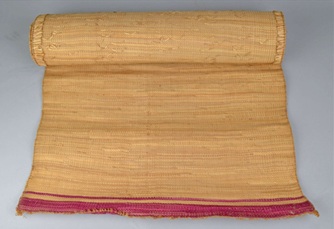
(Photo 1: “Namaadhu Kunaa” from the British Museum)
- “Mussala Kunaa”: Designed so that the center portion indicates the direction of the Mihrab, similar to a prayer mat (“Mussala”).
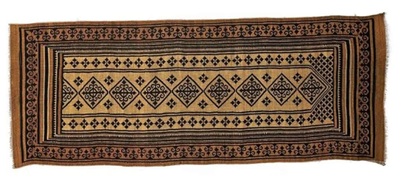
(Photo 2: “Mussala Kunaa” from the British Museum)
- “Salawat Kunaa”: Measures approximately 1.5 feet by 3 feet. Used in earlier days to hold incense sticks while reciting “salawat.”
- “Gondi Kunaa”: Considered as the most common type of Kunaa. Its name derives from the traditional Maldivian long chair (Dhigu gondi) and swing (undhoali), on which the mat was placed.
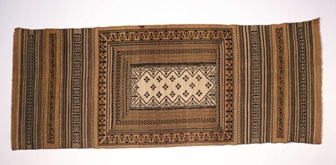
(Photo 3: “Gondi Kunaa” from the British Museum)
- “Karudhaas Kunaa”: Known for its highly polished appearance.
- “Kalhujehi Kunaa”: Considered a modern version of Kunaa. Unlike traditional Kunaa, which uses natural dyes, this type incorporates synthetic violet dye. Priced more affordably than other Kunaas.
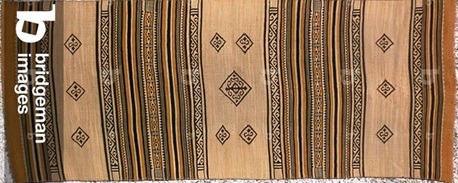
(Photo 4: “Kalhujehi Kunaa” purchased by Andrew Forbes in 1977)
- “Kunaa Kolhu”: Historically the most significant type of Kunaa. Originally produced as a gift for royalty. As per the information, currently, only two individuals in Gadhdhoo possess the knowledge and skill to weave this design.
- “Boafaijehi Kunaa”: Renowned for its exceptional beauty. Features a “boafai” design prominently placed in the center.
- “Thalufaajehi Kunaa”: Little information is available; therefore, details are not included in this article.
Design/Pattern names in Kunaa
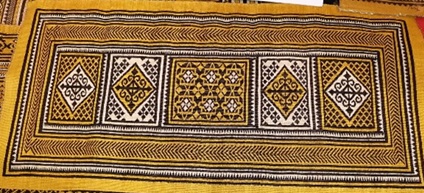
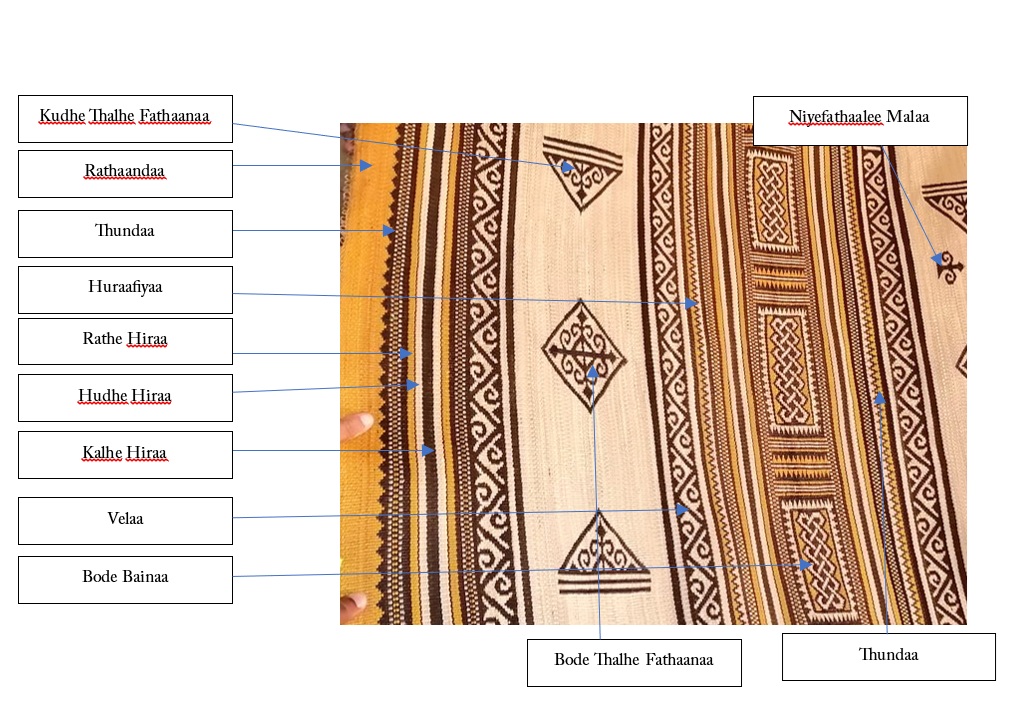
The decorative patterns woven into Thun’du Kunaas play a crucial role in Maldivian handicrafts. These motifs are deeply intertwined with Maldivian history and culture, having been passed down through generations. However, a notable aspect of these design names is that they do not appear in standard Dhivehi; rather, they exist purely in the Huvadhoo dialect.
This emphasis on the Huvadhoo dialect underscores the remarkable craftsmanship of the people from Huvadhoo Atoll. Each individual pattern or motif has its own unique name, such as “Kudhe Thalhe Fathaanaa,” “Bodu Thalhe Fathaanaa,” “Rathaandaa,” “Kalhe Hiraa,” “Hudhe Hiraa,” “Rathe Hiraa,” and “Niyefathaalee Malaa.” These names provide insight into the specific designs and shapes found in the Kunaa.
The use of Huvadhoo dialect names illustrates the richness and diversity of the Dhivehi language, offering both an appreciation for Maldivian linguistic heritage and a hope that these unique cultural elements will continue to thrive.
Conclusion
Kunaa weaving stands out as a prominent element of Maldivian cultural heritage, reflecting both skill and tradition. Mastering this craft requires significant time, patience, and dedication, yet it is crucial for preserving Maldivian culture and passing these skills on to future generations.
The architecture and design of the Thun’du Kunaa highlight Maldivians’ innovation and craftsmanship. Although different theories exist regarding the original design’s influences, there is no doubt that Thun’du Kunaa is a uniquely Maldivian art form.
Weaving Thun’du Kunaas connects past generations with future ones. It is a tradition that has been meticulously handed down through countless generations, and today’s Maldivians have the responsibility to safeguard and promote this precious skill. By learning, developing, and sharing the art of Kunaa weaving, the community ensures its continued vitality and significance as part of the nation’s cultural identity.
Ultimately, nurturing Kunaa weaving is a collective effort. Embracing it as a national endeavor will help strengthen Maldivian heritage and inspire the next generation to appreciate and uphold this remarkable tradition.
--------------------------
Written by: Ismail Mamdhooh